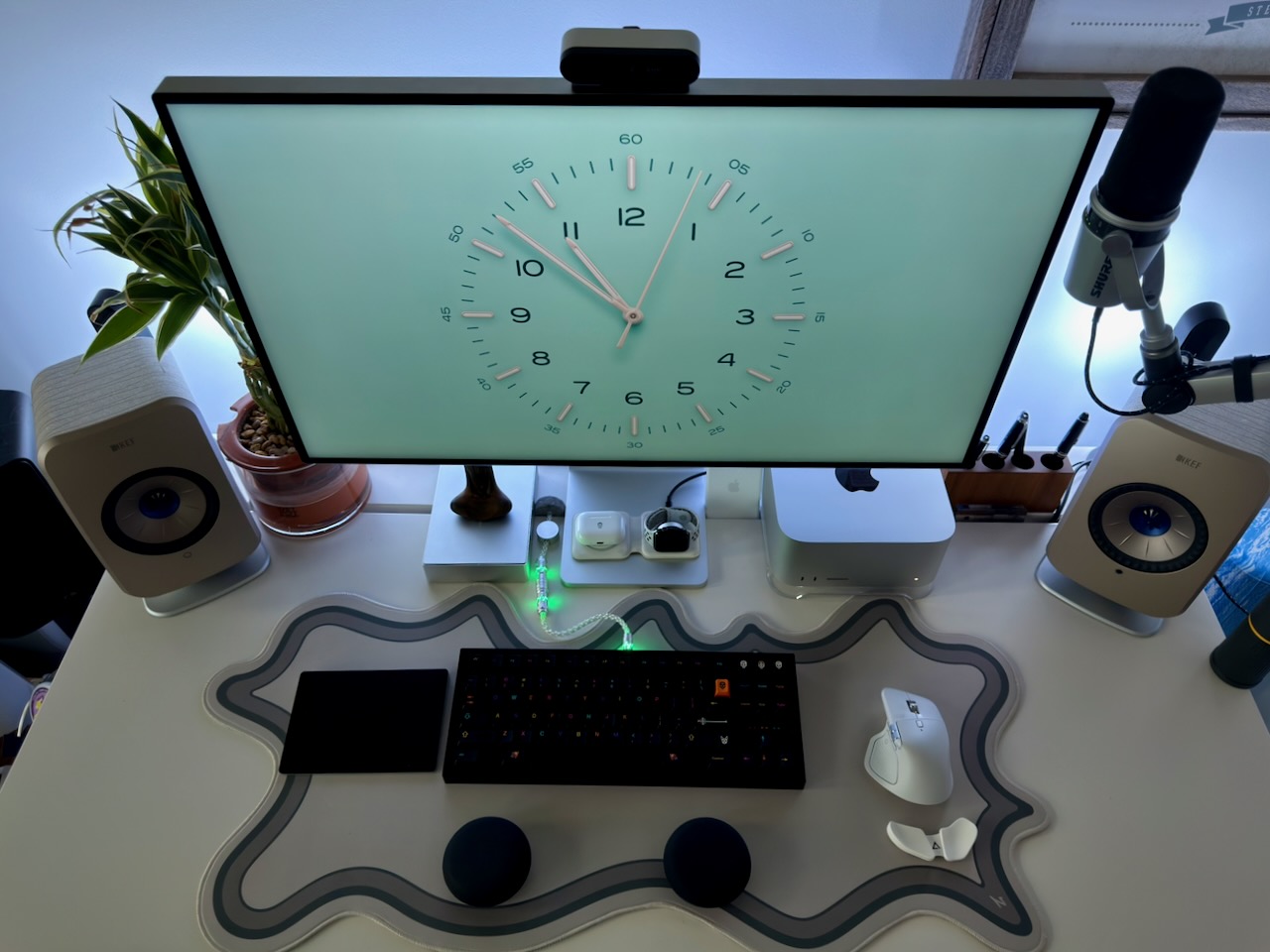
This is the gear layer of focus architecture.
The Pro Display XDR and Mac Studio are the anchors of the setup. Everything else gets arranged around them.
The Pro Display XDR on the Pro Stand is the visual anchor. Sharp, stable, and consistent in a way that lets the rest of the desk settle around it. A display this central cannot be another variable. It has to remove doubt. The Pro Stand is ridiculous, which is true right up until the moment it is on the desk doing exactly what it should. Then it becomes the expensive admission that the obvious answer was still the right one.
The Mac Studio is the system anchor. Configured with the Apple M3 Ultra, 256GB of unified memory, and 16TB of storage, it handles both desktop and server responsibilities without turning the desk into a compromise. The point is not spectacle. The point is calm headroom in a small footprint. The spec is overkill in the same way a strong foundation is overkill. Fine right up until the workload shows up and the machine refuses to blink.
The input layer is mixed on purpose. The IRON180 gives the desk weight, rhythm, and physical certainty. It also lives up to its namesake by being heavy as f*ck, which in this case is not a bug. The MX Master handles precision and long-session comfort without gimmick energy. The Magic Trackpad stays for the moments when gestures are better than clicks. The Magic Keyboard with Touch ID stays hidden behind the Pro Display XDR, available when needed, but never visually in charge. One input method is not enough for every kind of work, and pretending otherwise is how setups become ideology instead of tools.
Audio solves two different problems. The KEF LSX II add depth without adding clutter. They make the desk feel inhabited instead of only assembled. The Shure MV7 solves the less glamorous problem of being heard clearly. Not atmosphere, but signal. Calls, recordings, and voice notes need clarity without turning the desk into a podcast starter kit.
The support layer matters because comfort compounds. The Artifox Desk 02 and Håg Capisco keep the setup from drifting into office nonsense. The desk reads like furniture instead of office spillover. The chair keeps the posture active instead of letting the body melt into excuses. The desk mat, wrist supports, stand, and balance board handle the wear without asking for attention. A setup stops being good the second the body starts filing complaints.
Lighting is part of the structure, not decoration. Of course any lighting could do the job. Hue is here because most alternatives stop at illumination, or start falling apart the second the setup asks for more than color on command. Cheaper systems can light a room. Hue shapes one. Stable enough to trust, flexible enough to tune, and polished enough that the lighting feels architectural instead of gimmicky. It adds depth when the room needs atmosphere and cleaner light when the desk needs clarity. Less flatness. Less fatigue. Better mood. Good lighting changes how long a setup stays usable.
The wall treatment and smaller objects keep the room from going sterile. Too much tech talking only to itself makes a setup feel dead. The custom Etsy-framed Think Different campaign piece does more than fill wall space. It gives the setup a point of view. The plant and smaller objects keep the whole thing from taking itself too seriously. A little warmth and organic contrast keeps the room human, which is useful when the rest of the room starts looking like aluminum negotiating with glass.
What changed is less about one dramatic swap and more about refinement. The setup got stricter about its own logic. Fewer things there because they looked good in isolation. More things there because they proved useful under repetition. That is the only test that matters. A good setup is not the one with the most gear. It is the one where the wrong pieces quietly disappear and the right ones outlast the urge to rearrange everything for no reason.
That is the real follow-up. A desk setup is not only what is on it. It is the record of what kept proving useful.