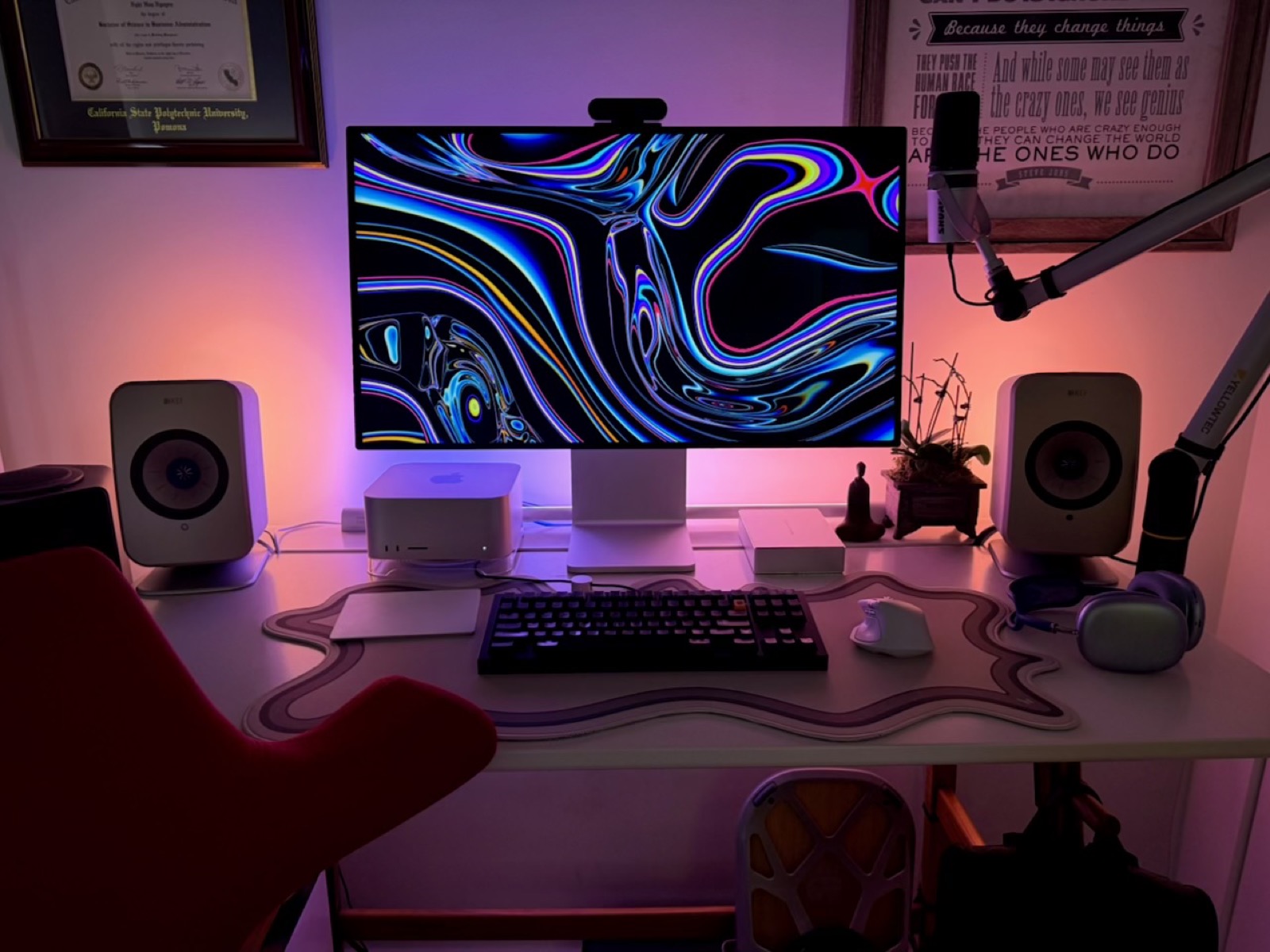
Desk setups became more prominent during the COVID years, first out of lockdown necessity, then out of hybrid-work reality.
What started as improvised survival turned into something more deliberate. People were no longer passing through an office someone else built for them. They were spending full working days inside their own space, which meant the space started revealing everything. Bad chairs. Bad lighting. Laptop neck. Cable chaos. Echo. Clutter. Screens too low. Tables pretending to be desks. Once work moved home, the setup stopped being background and became part of the job.
That is why a desk setup is never only a desk setup.
People talk about them like decoration, gear flex, or internet wallpaper. Sometimes they are. But at their best, they are operational. A physical interface for how you think, work, and recover focus.
Mine is built around that idea. Every piece on the desk has a job.
The display is the anchor. Big enough to hold attention without crowding it. Centered, lifted, and placed where my neck does not have to negotiate with it. It sets the visual field for everything else.
The speakers are not only for audio. They change the density of the room. Music when I need flow. Film when I want the desk to stop feeling like work. Clean sound makes the setup feel inhabited, not only assembled.
The microphone arm stays ready for calls, recordings, and voice notes without colonizing the desk.
The keyboard and mouse are the daily contact points. That is where cheapness gets exposed first. If your hands touch something for hours, it should disappear into use. The keyboard gives the desk physical rhythm. The mouse keeps movement precise. Neither should ask for attention once work starts.
The trackpad gives me gestures when clicks feel too blunt. Switching between the two keeps the desk from locking into one mode of thinking.
The desk mat marks the working zone. Not in a precious way. In a functional one. It softens contact, reduces noise, and gives the center of the desk a boundary.
The charging area is less about convenience than reset. Watch, AirPods, phone, and accessories all return to one place, which keeps the desk from collecting visual leftovers.
The computer itself stays compact and quiet, which matters more than people admit. Good machines should feel present in output, not in noise, heat, or spatial arrogance.
Lighting plays a bigger role than most people realize. I use Philips Hue lighting to shape mood and focus depending on the time of day and the kind of work I am doing. It brings depth to the room, keeps the desk from feeling flat, and makes long hours feel less clinical. Good lighting does not only help you see. It changes how a space thinks with you.
Wall treatment matters too. Not only visually, but acoustically. Panels, texture, art, shelving, whatever lives behind the desk changes how the room holds sound, light, and attention. It is easy to treat the wall like leftover space, but it is part of the setup’s atmosphere. Get it right and the whole room feels more resolved.
Even the plant earns its place. Not as décor filler. As a break in the hard edges. Screens, aluminum, glass, plastic, metal. A little organic contrast keeps the setup from feeling sterile.
I also change the setup around at least twice a year. Not because it is unfinished, but because even a good workspace can go stale. Small shifts in layout, lighting, and placement keep the desk from going visually numb and keep the room thinking with me.
That is the point of the whole thing. The desk is not there to impress anyone. It is there to reduce friction. To support focus when I need to produce, and to hold enough atmosphere that creativity has somewhere to land when it shows up.
When a setup is right, you feel it before you think about it. You sit down, and the room stops arguing with you.