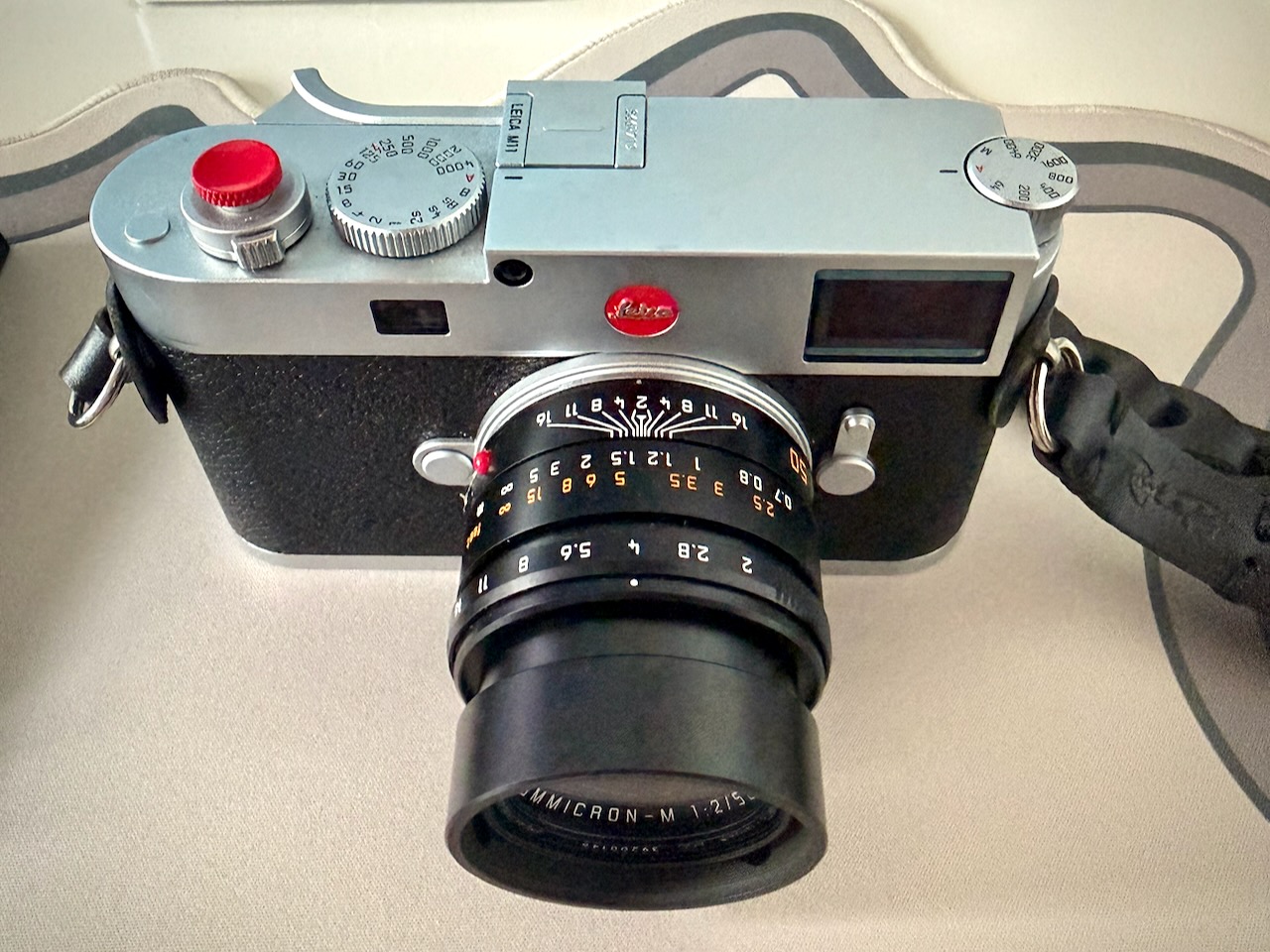
The Leica APO-Summicron-M 50 f/2 ASPH is what happened when I stopped pretending I wanted a lens collection.
I wanted to narrow down to a single lens. That decision sounds technical at first, but it is mostly about appetite. Too many focal lengths and the whole system starts turning into options management. You stop seeing and start choosing between possible versions of seeing. I did not want that. I wanted one lens that could stay on the camera, hold its ground across most of what I care about, and make the rest of the decision tree feel unnecessary.
The 50mm is the obvious answer.
Obvious not because it is boring. Obvious because it is the focal length that asks for the least explanation. It works for portraits. It works for street. It works for the daily middle where most real photography actually happens. Tight enough to isolate. Wide enough to stay connected. Natural enough that the frame rarely feels like a trick. The 50 does not impose itself. It clarifies.
That is why the APO version mattered.
Once I accepted that I wanted one lens to do almost everything, it had to be a lens I would not second-guess. Not something good for the money. Not something close enough. Not something I would quietly plan to upgrade out of later. If the whole point is reduction, the lens has to finish the argument.
The APO-Summicron does.
The first thing it gives you is quiet certainty. You raise the camera, focus, shoot, and the file comes back with an almost rude amount of control. Detail is there immediately. Edges hold. Contrast stays clean. The frame looks resolved fast. A lot of lenses have personality because they are compensating for a weakness people learn to romanticize. The APO has something better than personality. It has discipline.
Wide open, it is already there. Not good for f/2. Good, full stop. That matters because the lens does not make you negotiate with its best performance. You do not feel like you are carrying one lens for convenience and then paying for that convenience in softness, haze, nervous rendering, or some flattering excuse people like to call character. The APO does not need excuses.
The better surprise is that it does not turn cold.
That is the risk with optics this corrected. A lens this precise can easily flatten the photograph into demonstration. The APO avoids that. The files have structure without feeling hard. They hold detail without turning clinical. Faces look honest. Skin keeps its texture without becoming punitive. Background separation is clean without begging for attention. The image feels resolved, but still alive.
That is what makes it such a strong one-lens answer.
Once the APO stayed on the camera for a while, the bigger surprise was how quickly the rest of the focal lengths started feeling like interruptions. Fifty stopped feeling like a compromise and started feeling like the native shape of the world. Close enough for a face. Far enough for a street corner. Tight enough to exclude noise. Honest enough that framing stopped feeling like style and started feeling like judgment.
That shift is the whole win.
For portraits, the 50mm focal length already gives you the right starting point. Close enough for intimacy, far enough to avoid turning a face into an optical event. The APO builds on that by giving faces a kind of clarity that feels expensive in the correct way. Not beautified. Not smeared into cream. Not softened because the lens is trying to flatter on its own. It respects the subject. It does not decorate them.
For street, the same lens works because it keeps the distance honest. A 50 on an M body does not let you hide behind reach or disappear into exaggerated width. You have to be present enough to frame with intent. That ended up being part of why I liked it more, not less. The lens kept me in the scene. No gimmick perspective. No visual shouting. Focus lands, the frame locks, and the photograph either works on its own terms or it doesn't.
That matters more than people admit.
A one-lens setup should reduce self-consciousness. It should make you faster to trust the frame, not more aware of the equipment. That is exactly what this lens does. After a while, the 50 APO stops feeling like a premium object mounted on the camera and starts feeling like the camera's native state. That is when you know the reduction worked.
On my M11, it is the constant lens. After enough time together, it stopped feeling like a lens choice and started feeling like the body's correct default.
Of course, this is Leica, so honesty requires saying the obvious part clearly. The lens is expensive to the point of absurdity. Rational people will correctly point out that there are other 50s that can make beautiful photographs for far less money. They will not be wrong. The APO is not a value proposition. It is a final-form proposition.
That is a different category.
If you are shopping with a spreadsheet, this is not the answer. If you want maximum glow, maximum nostalgia, maximum vintage signature, this is also not the answer. The APO is not built around imperfection theater. It is built around control, clarity, and the idea that one lens can do nearly everything at an extremely high level without asking you to tolerate much of anything.
That was exactly what I wanted.
I did not want a 35 for one mood, an 80 for another, and a backup 50 sitting in between pretending to be compromise. I wanted one focal length and one lens that could carry portraits, street, and the daily middle without ever making me feel under-equipped. The 50mm was the obvious focal length. The APO-Summicron was the obvious version of it.
Not because it is sensible. Because it ends the conversation.
The Leica APO-Summicron-M 50 f/2 ASPH is the lens for when good enough starts feeling like clutter. One focal length. One answer. No excuses.