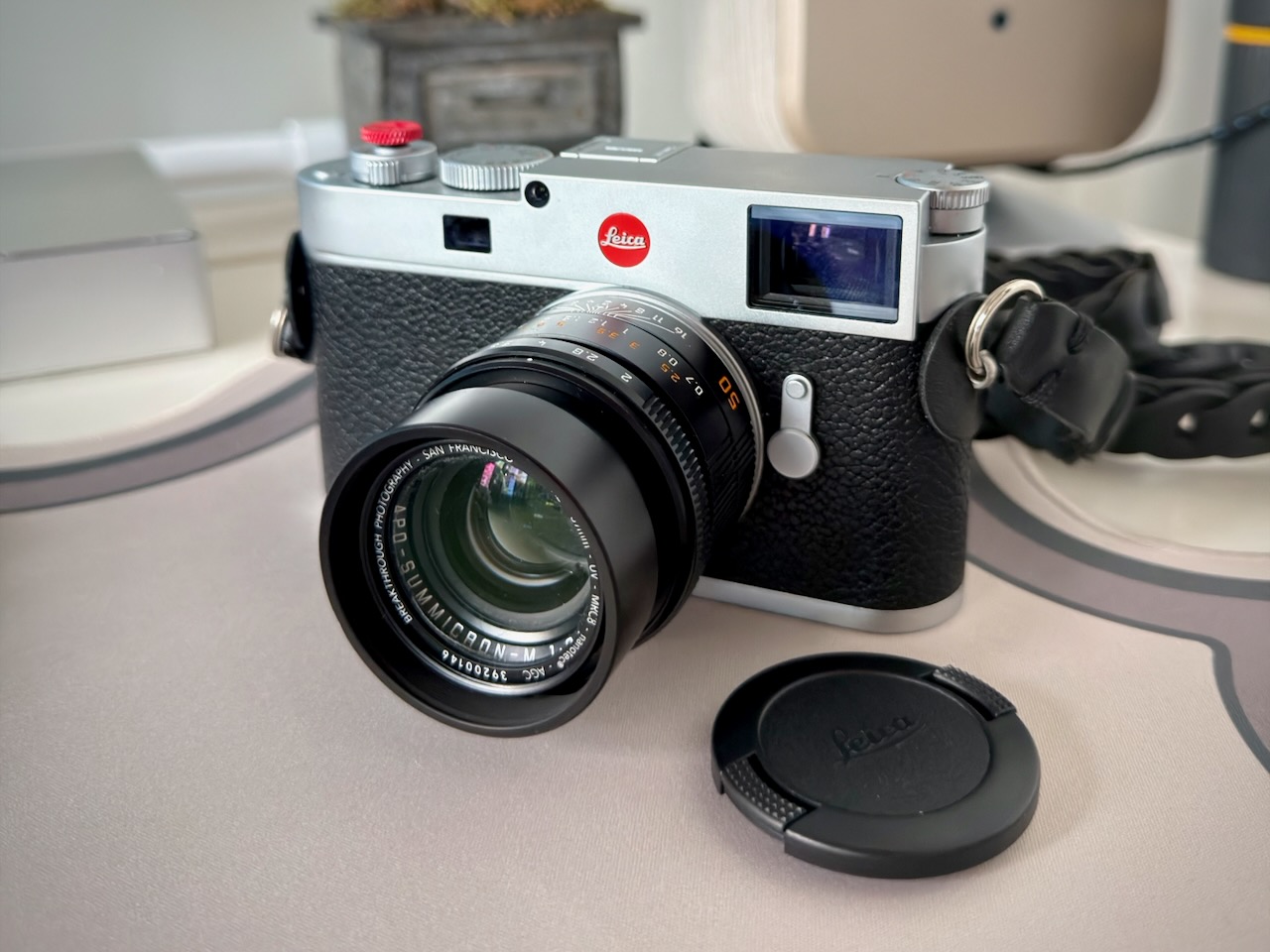
The Leica M11 is overkill for my use.
That is the honest place to start. I am not a professional photographer. I do not need this camera for work. Technically, it is more camera than my actual life requires, and there are easier, cheaper, more rational ways for me to take genuinely good photos.
I bought it anyway.
Part of that was circumstance. I came from the Leica M10, and it was stolen. So the M11 was the natural upgrade. Not because I suddenly needed more camera, but because I already knew the M system was the one I wanted to return to. Once that relationship was interrupted, the M11 made more sense than starting over somewhere else and pretending I wanted a different kind of experience.
That is the first truth of this camera for me. It was not an entry into Leica mythology. It was a return.
And if you already understand the M10, the M11 feels like exactly the version of that story you would want next. Same rangefinder discipline. Same stripped-down, deliberate way of shooting. Same feeling that the camera is asking you to participate instead of rescuing you with automation. But the whole thing arrives more resolved. More room in the files. Better endurance. More latitude without losing the point.
A lot of upgrades ask you to relearn the product. The M11 does not. It keeps the language intact. It still feels like an M, which is the whole reason to buy one in the first place. The camera slows you down in the correct way. It keeps your attention on framing, timing, and distance. It makes photography feel less like capture and more like decision.
That is what I am paying for more than the spec sheet.
Because on paper, this camera is absurd for me. A non-pro carrying around an M11 is not a rational value story. It is indulgent.
But it is not empty indulgence.
The M11 earns itself in use. Pick it up and the whole premise is immediately clear. No excess buttons begging for attention. No interface trying to look smarter than the photograph. No sense that the camera is doing too much on your behalf. You bring it to your eye, work the frame lines, focus with intent, and feel the pace of the image settle down. It is not fast in the modern-camera sense. It is clarifying. It cuts away enough noise that the photograph either starts to come together or it doesn't, and that responsibility lands back on you.
That is the appeal.
Most modern cameras are built around reassurance. Faster autofocus. More automation. More correction. More ways to save you from yourself. Useful, obviously. Also a little numbing over time. The Leica goes in the other direction. It removes enough assistance that making the image starts feeling like your responsibility again. That is not always easier. It is often better.
Coming from the M10, the M11 feels like Leica improved the camera without flattening its character. The files have more room to move. Cropping is less punishing. Recovery is more forgiving. There is a little more freedom after the fact, which matters for someone like me who is not shooting for clients, not delivering on deadlines, and not working under professional pressure. I want the image to hold up when I get something slightly wrong. The M11 gives me more room for that than the M10 did.
Battery life is another useful improvement.
The M10 always felt like a camera you had to respect logistically a little more than you wanted. The M11 feels calmer. Less like something you have to manage. That may not be the glamorous upgrade, but it is one of the most useful ones. It lets the camera stay where it belongs, which is in your hand and in your attention, not in the background of your mental checklist.
And the better surprise is that the M11 does not lose its soul under the extra resolution.
That is always the risk with cameras like this. More megapixels, more technical headroom, more reasons to talk about the sensor, and suddenly the files start feeling extracted instead of made. The M11 avoids that. The images still have that composed Leica quality people chase in the first place. The files have structure without feeling hard. They hold detail without turning the photograph into demonstration.
That balance is what keeps the camera from turning into a sterile luxury object.
Because yes, it is luxury. There is no honest way around that. The M11 is expensive far beyond what my actual needs require. It is overkill for a non-pro. It is overbuilt for the way I use it. Any practical person could make a strong case that it is too much camera.
They would not be wrong.
But they would also be missing the point.
The point is not that I need the M11. The point is that it makes me want to take photographs in a way few cameras do. It makes me look harder. Move slower. Commit earlier. Pay attention. The M10 already gave me that language. The M11 gives it back with more refinement, more latitude, and a little more ease.
That also explains why the Leica APO-Summicron-M 50 f/2 ASPH has become the constant lens on my M11. Once that lens settled onto this body, the camera stopped feeling like a platform for choices and started feeling complete.
That is why it was the natural upgrade.
Not because I can justify every technical advantage. Because I already knew what kind of camera experience felt right to me, and this is the cleaner version of it. The theft of the M10 made the decision emotional first, but the M11 has held up because it earns itself after the emotion wears off.
The Leica M11 is more camera than I need.
It is also the camera that makes me want to keep taking photos.
That matters more.