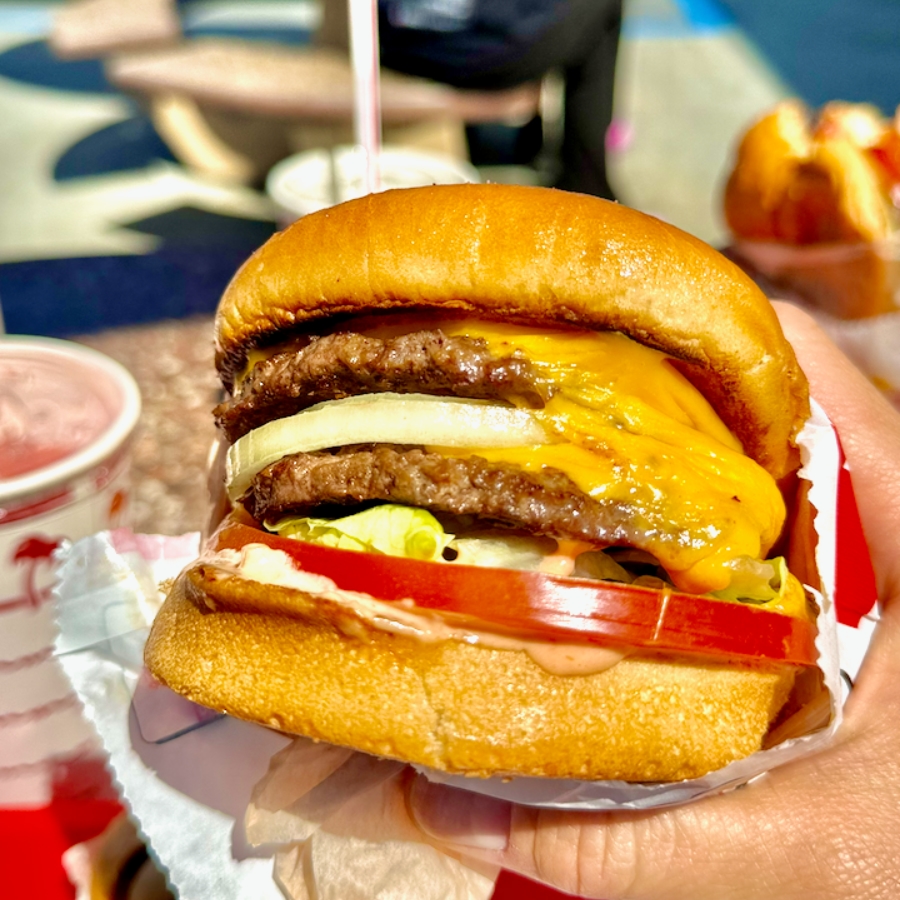
In-N-Out is the first place I go the minute I land in California, or honestly any state lucky enough to have one. That is not nostalgia talking itself into a ritual after the fact. That is the ritual. Before the nicer meal. Before the reservation. Before the city has a chance to introduce itself properly. In-N-Out first.
Growing up in Southern California does that to you.
It stops being only a burger chain and turns into part of the regional operating system. Not glamorous. Not rare. Not something you talk up because it is hard to get. The opposite. It is the baseline. The taste memory. The thing that tells your body you are back before your brain fully catches up. Palm trees, dry air, freeway loops, and that first bite of a Double-Double. Same category.
That is why it is hard to review In-N-Out like a normal burger place. It is not only food. It is calibration.
The first bite always does the same thing. It resets the clock a little. The paper wrap, the soft bun, the clean snap of lettuce, the sauce, the onions, the way the whole thing tastes so aggressively like itself and nothing else trying to be modern or clever. That is the miracle of it. In-N-Out has survived long enough to become mythology and still mostly tastes like reality.
A lot of beloved chains either calcify into memory or start chasing trends until the thing people loved gets buried under product development. In-N-Out stayed stubborn. The menu is still narrow. The branding still looks like it came from a more optimistic version of California. The stores still feel like they are built around motion instead of mood. It has held the line in a way most chains eventually fail to do.
The Double-Double is still the reference point.
Not because it is the biggest. Not because it is the most indulgent. Because it is the clearest expression of the place. Two patties, two slices of cheese, the full familiar stack, and nothing in it feels like a gimmick or a compromise. It tastes balanced in the old-fashioned way, by which I mean it tastes like someone still believes a fast-food burger should be recognizable as a burger.
That sounds obvious until you remember how many places no longer do.
A lot of burgers now feel like they were designed backward from marketing. Too much sauce. Too much salt. Too much sugar. Too much architecture. Too much wanting you to notice the concept instead of the thing itself. In-N-Out still works because it is simple without being flat. The ingredients stay legible. The whole thing eats clean. You finish it feeling satisfied, not ambushed.
That is part of why it became the first stop whenever I land.
Travel has a way of making you want one of two things. Either total novelty or immediate familiarity. In-N-Out is the second kind, and it does that job perfectly. It is the California reset. The meal that puts the ground back under your feet. No decision fatigue. No overthinking. No trying to optimize the first meal back. You go, you order, it lands, and the state starts making sense again.
And yes, the secret menu is part of the language.
Not because it is actually secret anymore. That fiction has been dead for years. But because learning how to order there is still part of the culture around it. Animal Style when you want the messier, louder version. Protein Style when you want less bread and more focus. 3x3 or 4x4 when you are actually hungry or pretending you are. Well-done fries when you want more structure and less softness. It is not a hidden code so much as a familiar local dialect.
That said, the fries remain the most honest argument against the place.
They are fresh, unmistakably so, and still divisive for a reason. In-N-Out fries can be great in the right window and underwhelming the minute that window closes. They do not have the engineered addictiveness of chain fries designed to survive time, distance, and bad luck. Sometimes that is charming. Sometimes that is annoying. Ordering them well-done helps if you want more snap and less of the softer, paler version that turns so many people against them.
That is the thing about In-N-Out. Its strengths and weaknesses come from the same source. It is more literal than most fast food. More direct. Less padded by food science tricks that smooth out every edge. When it hits, it feels cleaner and more specific than the competition. When it misses, there is less disguise.
I still take that trade.
Because the upside is the whole point. In-N-Out tastes like a chain that still believes restraint can be a flavor. The burger does not need to stunt. The experience does not need to explain itself. It shows up, does the job, and leaves you happier than you planned to be. That is harder to pull off than people admit.
It also helps that the whole place still feels culturally coherent. The packaging. The colors. The script on the cups. The employees in white hats. The slight sense that the brand belongs to an older, cleaner California idea that somehow survived into the present. It has not been fully ironed out by consultants. It still has local emotional weight.
That is why people from California talk about it the way they do. Not because it is the best burger in every technical category. It isn’t. Not because the menu is broad. It isn’t. Not because the fries are beyond criticism. They definitely are not. But because it occupies a specific lane so completely that arguing with it starts to miss the point.
It is not trying to win every burger conversation.
It is trying to be In-N-Out.
That is more than enough.
For me, it is still the first stop after landing. The staple. The baseline. The edible version of being back. Plenty of places can give you a better burger in some narrower, more technical sense. Few can give you that first bite and make the whole state click back into place.
That is why it lasts. Not because it is perfect. Because it is itself, every time.